
The 8 Marketing Channels Every Startup Should Know (And How to Pick the Right One)
PART 3 OF 12 | THE STARTUP MARKETING PLAYBOOK

The Channel Trap
One of the most common mistakes early-stage founders make is choosing a marketing channel based on what they see other companies doing rather than what actually fits their business, their buyer, and their current stage.
The result is that time and budget are poured into channels that don’t pay off, while the highest-yield channels sit untouched.
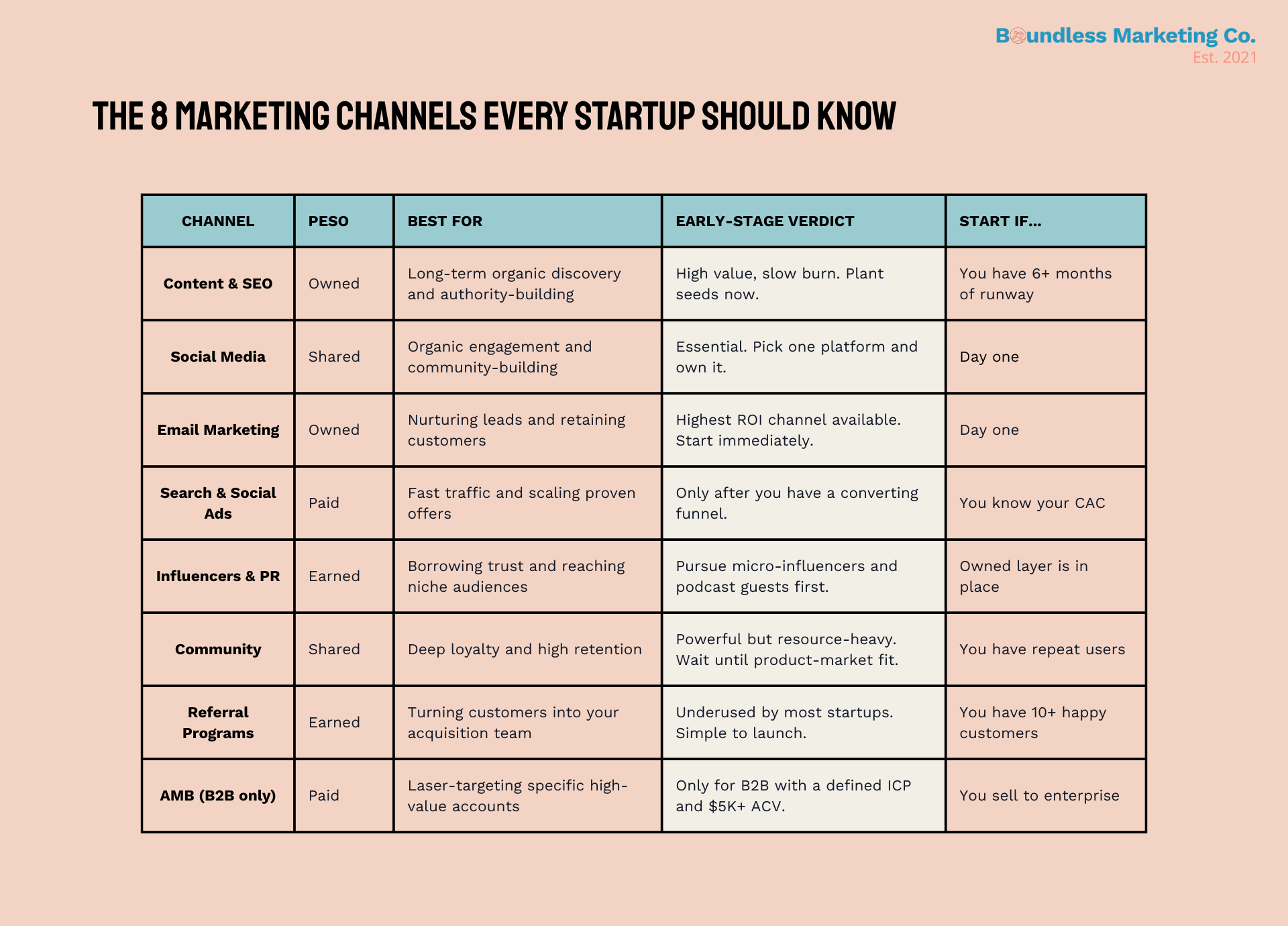
Consider this blog your channel reference guide. We’ll walk through 8 core marketing channels, what each one is actually good for, and an honest verdict on when it makes sense for an early-stage SaaS or tech company to prioritize it
Channel 1: Content and SEO (Owned)
What it is
Content marketing and SEO work together to make your business discoverable by people who are actively searching for solutions to the problem you solve. You create high-quality content such as blog posts, guides, videos, and case studies, optimized for the keywords your buyers use. Over time, Google rewards that content with rankings, and those rankings drive a steady stream of organic traffic.
Why it matters
SEO is the only marketing channel that genuinely compounds. A well-written blog post can drive qualified traffic for years without any additional spend. For SaaS companies with long sales cycles, content also builds credibility and trust across multiple touchpoints before a buyer ever reaches out.
The honest verdict
High value, slow burn. If you plant the seeds now, you will be grateful in 12 months. But do not expect SEO to drive leads in the first 90 days–it rarely does. Start it early, track it patiently, and supplement with faster channels while it builds.
Start if...
You have at least 6 months of runway, someone who can write professionally and consistently, and a clear understanding of what keywords your ideal customers search for.
Channel 2: Social Media (Shared)
What it is
Organic social media, like posting on LinkedIn, Twitter/X, Instagram, TikTok, or niche community platforms, is how you build an audience of potential customers, partners, and champions over time. It is a shared channel because your content can be amplified by others, creating reach beyond your own followers.
Why it matters
Social media is one of the few channels where a solo founder with zero budget can build a meaningful audience. Founder-led content in particular, like posts where the CEO shares real opinions, hard-won lessons, and behind-the-scenes perspective, consistently outperforms polished brand content.
The honest verdict
Essential for nearly every SaaS startup, but only if you commit to one platform. Spreading yourself across five channels with mediocre content is worse than dominating one with great content. For most B2B businesses, that platform is LinkedIn.
Start if...
You can post consistently at least three times per week. If you cannot commit to that, do not start. An abandoned social presence won’t kill you, but you’ll waste time posting if you aren’t committed to it long-term.
Channel 3: Email Marketing (Owned)
What it is
Email marketing is the practice of building a list of people who have given you permission to contact them and then using that list to nurture relationships, deliver value, and drive conversions over time. It includes newsletters, drip sequences, product updates, onboarding flows, and re-engagement campaigns.
Why it matters
Email marketing consistently delivers the highest ROI of any marketing channel because it’s direct. You’re not at the mercy of an algorithm. An email list is also an asset you own outright. No platform can take it away from you!
The honest verdict
Start building your email list on day one. Even if you only have 20 subscribers, those 20 people opted in to hear from you–and that is more valuable than 2,000 passive social followers who can be hidden by an algorithm tomorrow.
Start if...
You are willing to consistently show up in someone's inbox and add genuine value every time. An email list you never send to is a missed opportunity. An email list you spam is a liability.
Channel 4: Search and Social Ads (Paid)
What it is
Paid advertising, including Google Search Ads, LinkedIn Ads, Meta Ads, YouTube pre-rolls, lets you buy access to your target audience immediately. Search ads capture people who are actively looking for a solution (high intent). Social ads interrupt people who are not actively searching but match your target profile (discovery-based).
Why it matters
Paid ads are the fastest way to generate traffic and test offers. They give you immediate data on what messaging resonates, which audiences respond, and what your conversion rates look like; that’s all information that can sharpen every other channel you run.
The honest verdict
Paid media amplifies what already exists. If your website converts and your offer is proven, ads can be the fuel that keeps the fire burning. If your foundation is weak, you are paying to expose that weakness at scale. Get the owned layer right before you invest significantly in paid.
Start if...
You have a high-converting landing page, a clear offer, and a budget you can afford to lose while you learn. A minimum viable ad test is usually $1,000 to $2,000 over 30 days. Aim for at least 1,000 pairs of eyes on the landing page you’re testing for statistically significant data.
Channel 5: Influencers and PR (Earned)
What it is
Earned media through influencers and PR means getting third parties like journalists, industry analysts, podcasters, niche creators, or respected practitioners to talk about your product. Unlike paid sponsorships, this is coverage you earn through relationships, news value, or genuine product quality.
Why it matters
Earned media is the most credible form of marketing because it comes from voices your buyers already trust. A mention in an industry newsletter your prospects read every week is worth more than a display ad they scroll past.
The honest verdict
For early-stage startups, skip the big-name press and focus on micro-influencers, trade publications, and podcast appearances in your specific niche. A guest spot on a 2,000-listener podcast full of your exact buyers will outperform a mention in a major publication that reaches a general audience.
Start if...
Your owned layer is in place. If someone reads about you and visits your website, there needs to be something worth finding there.
Channel 6: Community (Shared)
What it is
Community marketing means building or actively participating in spaces–consider Slack groups, Discord servers, private forums, or LinkedIn groups–where your customers gather, share knowledge, and support each other.
Why it matters
A well-run community creates some of the highest retention and word-of-mouth of any marketing channel. When customers feel like they belong to something, they stick around, and they tell others.
The honest verdict
Community is powerful but resource-intensive. Building a community from scratch before you have product-market fit is like building a stadium before you have a team. Focus first on participating in existing communities where your buyers already gather, then consider building your own once you have a base of engaged customers.
Start if...
You have at least 50 to 100 active customers and someone on your team who can dedicate meaningful time to community management.
Channel 7: Referral Programs (Earned)
What it is
A referral program systematically incentivizes your existing customers to drive new customers your way. This can be a formal program with tracked referral links and cash rewards, or something as simple as a structured process for asking happy customers for introductions.
Why it matters
Referred customers close faster, churn less, and have higher lifetime value than customers from almost any other channel. They arrive with built-in trust because someone they already know vouched for you.
The honest verdict
Referral programs are one of the most underused channels in early-stage SaaS. Most founders wait until they have a formal program before asking for referrals -- but the informal ask is often just as effective and costs nothing to begin. If you have 10 happy customers, you can launch a referral strategy today.
Start if...
You have at least 10 customers who are genuinely satisfied with your product. Do not ask unhappy customers for referrals, as it damages the relationship and rarely works, anyway.
Channel 8: Account-Based Marketing/ABM (Paid/Owned)
What it is
ABM is a B2B strategy in which you identify a specific list of high-value target accounts and run highly personalized marketing campaigns aimed at those exact companies, rather than broadcasting to a wide audience. It typically combines paid ads, personalized content, direct outreach, and sales coordination.
Why it matters
For B2B companies selling to mid-market or enterprise accounts, ABM can dramatically shorten sales cycles and improve close rates by ensuring that your top prospects are seeing your brand consistently across multiple touchpoints before your sales team ever makes contact.
The honest verdict
ABM is not for everyone. It requires a well-defined Ideal Customer Profile (ICP), a strong sales-marketing alignment, and an average contract value (ACV) high enough to justify the investment. If your ACV is under $5,000 and you do not have a dedicated sales team, the other seven channels will serve you better.
Start if...
You sell to enterprise or mid-market B2B accounts, your ACV is $5,000 or higher, and you have clear alignment between your marketing and sales teams on which accounts to target.
So, Which Channel Should You Start With?
If you take nothing else from this post, remember this:
Start with email marketing and one social media platform. These are your lowest-cost, highest-leverage starting points.
Add content and SEO as soon as you can commit to consistency. The earlier you start, the more it compounds.
Layer in earned channels, like referrals and podcast appearances, once you have happy customers and a working product.
Introduce paid advertising only after you have a proven offer and a converting funnel.
Consider community and ABM once you have reached product-market fit and have the team to support them.
The right channel at the right stage beats the best channel at the wrong stage every time. Start focused. Add complexity only when the foundation is solid.
The Bottom Line
There is no universal best channel. There is only the best channel for your buyer, your product, and your current stage. Use this breakdown as a reference every time you are tempted to add a new channel to your mix, and ask yourself honestly whether the conditions for success are actually in place.
Up Next: In Part 4, we draw a clear line between B2B and B2C marketing strategy–the channels, decision drivers, and sales cycles are fundamentally different, and the distinction changes everything about how you invest your marketing resources.
About This Series: This post is part of The Startup Marketing Playbook, a 12-part newsletter and blog series for tech and SaaS founders. Each installment covers one core concept in depth, with actionable frameworks you can implement immediately.