
The PESO Model Explained: How Startups Build a Marketing Engine That Pays Itself Back
PART 2 OF 12 | THE STARTUP MARKETING PLAYBOOK

Photo Credit: Boundless Marketing Co.
Here is a pattern that plays out in hundreds of early-stage startups every year: A founder launches a product, needs customers, and starts marketing. They run some Facebook ads. They get a burst of traffic. The campaign ends, the traffic disappears, and the cycle starts over with the next campaign.
It feels like a treadmill, requiring constant effort. And the reason is simple: these founders are treating marketing as a series of disconnected campaigns rather than a system with interconnected parts.
The PESO model is the antidote to that.
What Is the PESO Model?
The PESO model is a framework that categorizes every marketing and communications channel into one of four types: Paid, Earned, Shared, and Owned.
More importantly, it shows how those four types interact and reinforce each other over time, creating a compounding engine rather than a series of one-off campaigns.
Here is a breakdown of each layer:
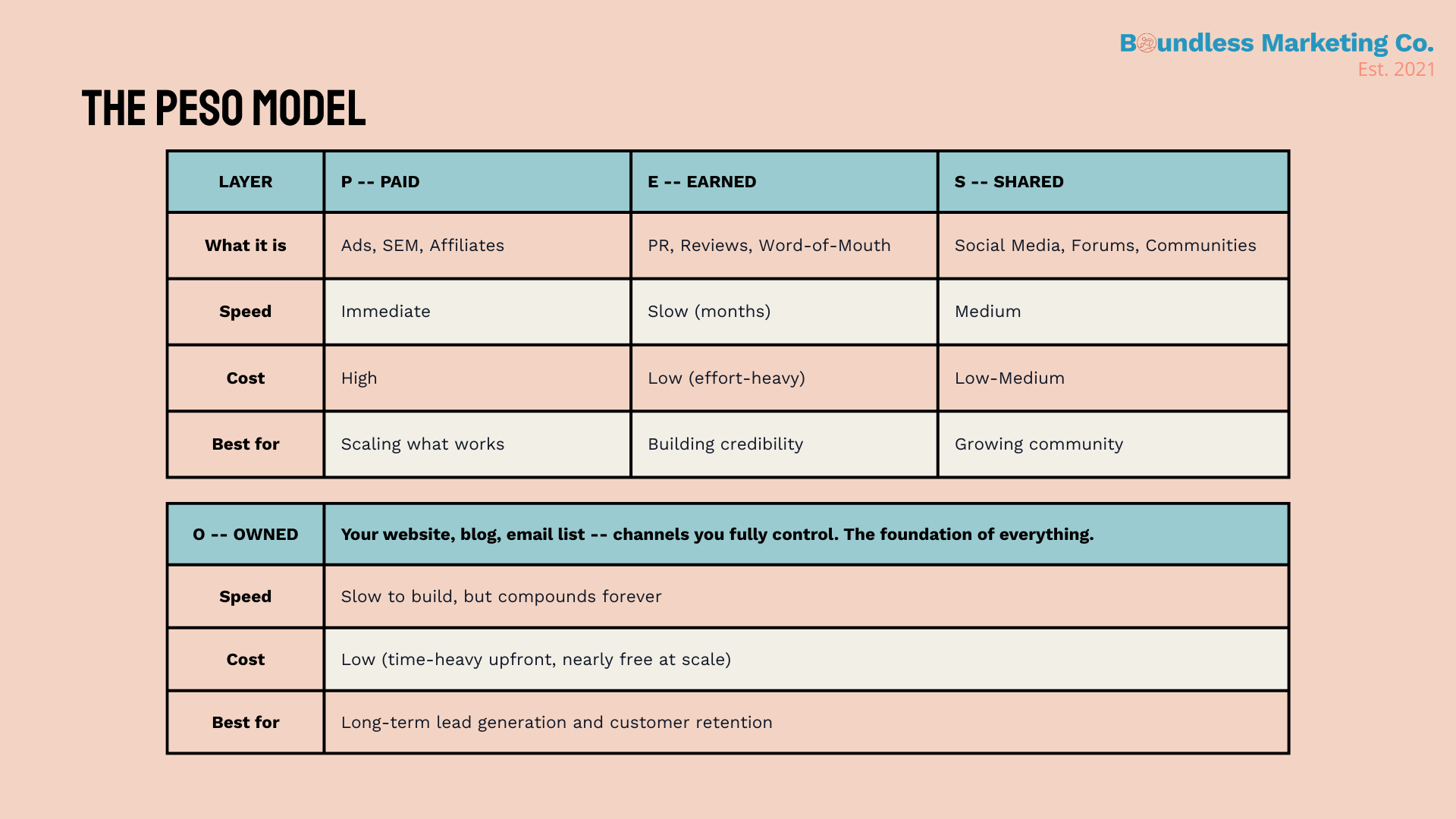
The Owned Layer: Your Foundation
Owned media is everything you control: your website, your blog, your email list, your podcast, your YouTube channel. It is the only marketing channel where you are not at the mercy of an algorithm, an ad platform, or a third-party editor. Your owned channels are very powerful!
For SaaS startups, the owned layer typically includes:
A product-focused website with clear messaging and conversion paths
A blog or content hub targeting keywords your buyers actually search for
An email list you can reach directly, without paying for access
The owned layer is slow to build. It takes months of consistent content to develop SEO traction, and building an email list from zero requires patience. But once it is working, it compounds. A blog post written today can drive leads for years. An email list of 5,000 engaged subscribers is an asset you own outright.
Think of owned media as your marketing home base. Every other channel should ultimately be driving people back to a destination you control.
The Earned Layer: Borrowed Trust
Earned media is third-party validation: press coverage, customer reviews, case studies, podcast appearances, analyst mentions, and word-of-mouth referrals. You cannot buy it directly; rather, you earn it through consistent quality, relationships, and results.
For early-stage SaaS companies, the most accessible forms of earned media are:
G2 or Capterra reviews from early customers
Case studies with measurable outcomes tied to real client results
Podcast appearances or guest posts in industry publications
Customer referrals through informal word-of-mouth
Earned media is the most credible form of marketing because it comes from voices your buyers already trust. A glowing review from a peer carries more weight than the most polished ad campaign. The challenge is that it is slow and unpredictable–you cannot simply schedule it the way you can a blog post or an ad.
The Shared Layer: The Conversation
Shared media is the social layer. Think LinkedIn, Instagram, TikTok, industry Slack groups, Reddit, and online communities. It’s called shared because its defining feature is that content is passed between people, rather than broadcast from a single source.
For B2B SaaS companies, the shared channels that drive the most meaningful engagement are typically:
LinkedIn for thought leadership posts, founder-led content, and company updates
Industry-specific communities like Slack groups, Discord servers, niche subreddits
Twitter/X for real-time conversation, especially for developer-focused products
The key to shared media is showing up consistently and adding genuine value, not just broadcasting product updates. The goal is to be the account that people in your niche actually look forward to following.
The Paid Layer: The Accelerant
Paid media–including search ads, social ads, display advertising, sponsored content, and affiliate programs–is the channel most founders reach for first. And while it can drive results, it is most effective when treated as an accelerant, not a foundation.
Here is the thing about paid media: it’s designed to amplify what already exists. If your owned content is strong and converting, paid can pour fuel on it. If your owned foundation is weak, you are paying to drive people to a leaky bucket.
A common, expensive mistake in startup marketing is running paid ads before the owned and earned layers are in place. You get traffic, but no trust, no conversion, and no retention.
The right time to lean into paid is when you have a proven offer, a high-converting landing page, and a clear understanding of your customer acquisition cost.
The Compounding Effect: How PESO Works Together
The real power of the PESO model lies not in any single channel but in how the four layers reinforce one another over time. Here is what that could look like in practice for a startup:
You publish a detailed blog post (owned) targeting a pain point your buyers face.
A journalist finds it and references it in an article (earned). Your credibility gets a third-party stamp.
You share the article on LinkedIn and in a relevant Slack community (shared). Your followers amplify it, and new people discover you.
You run a targeted LinkedIn ad (paid) promoting the post to your exact target titles, now backed by the earned press mention.
Each layer made the next one more effective. That is the compounding effect, and it is the difference between a marketing treadmill and a marketing engine.
How to Apply PESO as an Early-Stage Startup
You do not need to activate all four channels at once. In fact, trying to do everything simultaneously is one of the most common reasons startup marketing underperforms. Here is a practical sequencing guide:
Start with owned. Build your website, nail your messaging, and start an email list on day one. Even if it is just 50 people, that list is yours.
Layer in earned. Ask your earliest customers for reviews and referrals. Reach out for one podcast appearance or guest post per month.
Add shared. Show up consistently on the one or two platforms where your buyers actually spend time.
Introduce paid strategically. Once you have a proven offer and a converting funnel, use paid to scale what is already working.
Owned is your home base. Earned is your social proof. Shared is your conversation. Paid is the fuel you add when the fire is already burning.
The Bottom Line
The PESO model is not a rigid checklist. It’s a lens for thinking about marketing holistically. When you understand how paid, earned, shared, and owned channels interact, you stop making random channel decisions and start building something that compounds.
The best marketing is not the loudest. It is the most connected.
Up Next: In Part 3, we will break down all 8 core marketing channels one by one -- and give you a clear verdict on which ones make sense at each stage of a SaaS startup's growth.
Subscribe to the newsletter to follow along each week!
About This Series: This post is part of The Startup Marketing Playbook, a 12-part newsletter and blog series for tech and SaaS founders. Each installment covers one core concept in depth, with actionable frameworks you can implement immediately.