
B2B vs. B2C Marketing Channels: A Side-by-Side Comparison for Founders
PART 4 OF 12 | THE STARTUP MARKETING PLAYBOOK | BLOG POST

The Problem with Generic Marketing Advice
One of the most common mistakes early-stage founders make is choosing a marketing channel based on what they see other companies doing rather than what actually fits their business, their buyer, and their current stage.
The result is that time and budget are poured into channels that don’t pay off, while the highest-yield channels sit untouched.
Consider this blog your channel reference guide. We’ll walk through 8 core marketing channels, what each one is actually good for, and an honest verdict on when it makes sense for an early-stage SaaS or tech company to prioritize itMost marketing content on the internet is written without specifying who it’s actually for. A post titled "The 5 Best Marketing Channels for Startups" might be drawing entirely from consumer brand experience. A framework built for a DTC e-commerce company will give you a very different playbook than one built for a B2B SaaS product, even if both are early-stage, VC-backed startups with similar team sizes and budgets.
The distinction between B2B and B2C marketing is not a minor nuance. It shapes which channels you use, what kind of content you create, how long your sales cycle is, how many people are involved in a purchase decision, and what "conversion" even means at each stage of your funnel.
This post draws that line clearly so you know which side of it you are on, and how that should influence every marketing decision you make.
How B2B and B2C Buyers are Fundamentally Different
Before getting into channels and tactics, it helps to understand why the two buyer types behave so differently. The core difference comes down to whose money is being spent and what the stakes are.
A B2B buyer typically spends company money, often requires approval from multiple stakeholders, and is accountable for the decision's outcome. If a VP of Sales buys a broken CRM tool, they may take the professional fall for that decision. That high level of accountability makes B2B buyers cautious, research-heavy, and slow to commit. They want case studies, references, ROI projections, and sometimes legal reviews before signing.
A B2C buyer, on the other hand, is usually spending their own money on something that primarily affects them. The stakes are lower, the decision timeline is shorter, and the emotional and social dimensions of the purchase carry far more weight. A consumer might buy a product because a friend recommended it, because they saw it on TikTok, or simply because the packaging was cute.
B2B buyers need to justify their decision rationally. B2C buyers need to feel good about it emotionally. Your entire marketing strategy should reflect which of those two truths applies to your buyer.
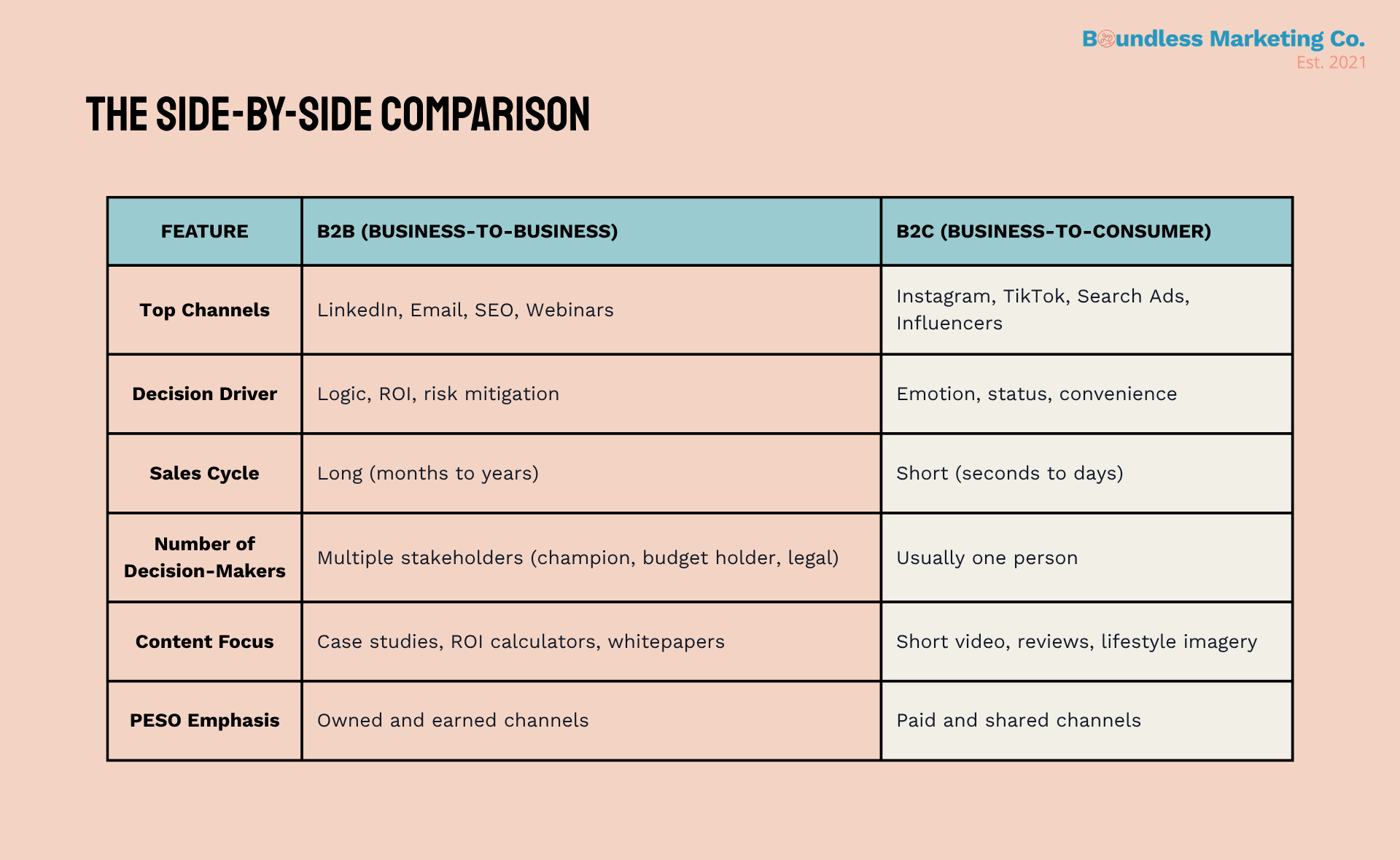
B2B Marketing: What Actually Works
If you are selling to businesses, here is where your marketing energy is best spent, particularly in the early stages.
LinkedIn and professional networks
LinkedIn is where B2B buyers spend professional time, build credibility, and research vendors. For most B2B SaaS companies, it’s the highest-leverage social channel available. Founder-led content, case study posts, and thought leadership pieces consistently outperform generic brand content on the platform.
The goal on LinkedIn is not to go viral. It’s to become a familiar, trusted presence to the specific community of people who could one day purchase from you.
Email nurture sequences
Because B2B sales cycles are long, most of your prospects are not ready to buy when they first encounter your brand. Email gives you a way to stay present and add value across a timeline that might span months. A well-designed nurture sequence moves a prospect from initial awareness through education, trust-building, and eventually intent, all without requiring your sales team to manually follow up at every step.
SEO and long-form content
B2B buyers research extensively before making decisions. They search for terms like "best project management software for agencies" or "how to reduce SaaS churn" long before they ever visit a pricing page. A strong content and SEO strategy puts you in front of those buyers during the research phase, before your competitors even know those buyers exist.
Webinars and case studies
Both of these are what we call "high-intent" content formats. Someone who registers for your webinar or downloads a case study is telling you they are actively evaluating solutions in your category. These formats deserve a dedicated place in any B2B marketing program.
B2C Marketing: What Actually Works
Consumer attention is fragmented and fast-moving. Short-form video on TikTok, Instagram Reels, and YouTube Shorts meets consumers where they already are and delivers your message in the format they are most likely to engage with. Paid social ads let you reach highly specific consumer segments at scale, test multiple creative angles quickly, and optimize toward purchase in a way that is measurable from day one.
Influencer partnerships
Social proof is one of the most powerful forces in consumer decision-making, and influencers are essentially professional social proof machines. A well-matched influencer partnership, especially with micro-influencers who have highly engaged niche audiences, can drive consumer trust in ways that brand advertising cannot replicate.
Reviews and ratings
Consumer buyers read reviews. For most e-commerce and consumer app categories, your review profile on Google, the App Store, or category-specific platforms is more influential than any ad you could run. Building a systematic process for earning reviews from happy customers is one of the highest-leverage marketing activities a B2C company can invest in.
Retargeting and lifecycle email
Even in B2C, email plays an important role, particularly for recovering abandoned carts, re-engaging lapsed customers, and driving repeat purchases. The difference from B2B is that B2C email sequences are usually shorter, more visual, and more emotionally driven.
What Happens When You Apply the Wrong Playbook?
This is where many early-stage founders waste significant time and money. A B2B founder who invests heavily in TikTok because they saw a consumer brand succeed there is unlikely to reach their actual buyers. A B2C founder who spends months building a long-form content and SEO strategy may find that their buyers were never searching for solutions in the first place.
Neither channel is wrong in theory. Both are wrong when applied to the wrong buyer type. Before committing budget or time to any marketing channel, ask yourself one question: Is this where my specific buyer actually makes decisions? If the answer is no, move on regardless of how well that channel is working for someone else.
A Note on Hybrid Models
Some companies sell to both businesses and consumers, or sell a consumer product with a B2B component, such as a freemium SaaS tool where individual users adopt the product and then upgrade to a team plan. These hybrid models require a thoughtful allocation of resources between the two playbooks.
The most common mistake in hybrid models is defaulting entirely to one playbook. If your individual users are consumers, they need consumer-style content and social presence. If your buyers are business decision-makers, they need B2B-style case studies and ROI framing. Both audiences deserve a strategy designed for how they actually make decisions.
The Bottom Line
B2B and B2C marketing are not just different in degree. They are different in kind. The buyers behave differently, the channels work differently, the content formats perform differently, and the timelines are categorically different.
The most useful thing you can do with this framework is to use it as a filter. Every time you encounter marketing advice, a new channel recommendation, or a case study from another company, ask yourself which buyer type that advice was built for. If it doesn’t match yours, set it aside without guilt.
Up Next: In Part 5, we go one level deeper on channel selection by introducing four buyer behavior patterns. Rather than categorizing channels by type, we will map them to how your specific customers actually make decisions, and what that means for where you show up.
About This Series: This post is part of The Startup Marketing Playbook, a 12-part newsletter and blog series for tech and SaaS founders. Each installment covers one core concept in depth, with actionable frameworks you can implement immediately.