
Stop Chasing Trends: How to Match Your Marketing Channel to Your Customer's Behavior
PART 5 OF 12 | THE STARTUP MARKETING PLAYBOOK | BLOG POST

Why Channel Selection Feels So Hard
Ask ten different startup founders which marketing channel they're using and you'll get ten different answers, each one justified with some version of "that's what's working right now." Someone heard that LinkedIn is having a moment. Someone else is convinced TikTok is the future of B2B. A third founder is going all-in on a podcast because their favorite industry leader has one. None of those are bad channels. But none of them is the right starting point, either.
The right starting point isn't the channel. It's the customer. Specifically, it's understanding how your customer behaves when they're in the market for a solution like yours. Once you've got that figured out, determining your marketing strategy becomes a lot more obvious.
The Four Buyer Behavior Patterns
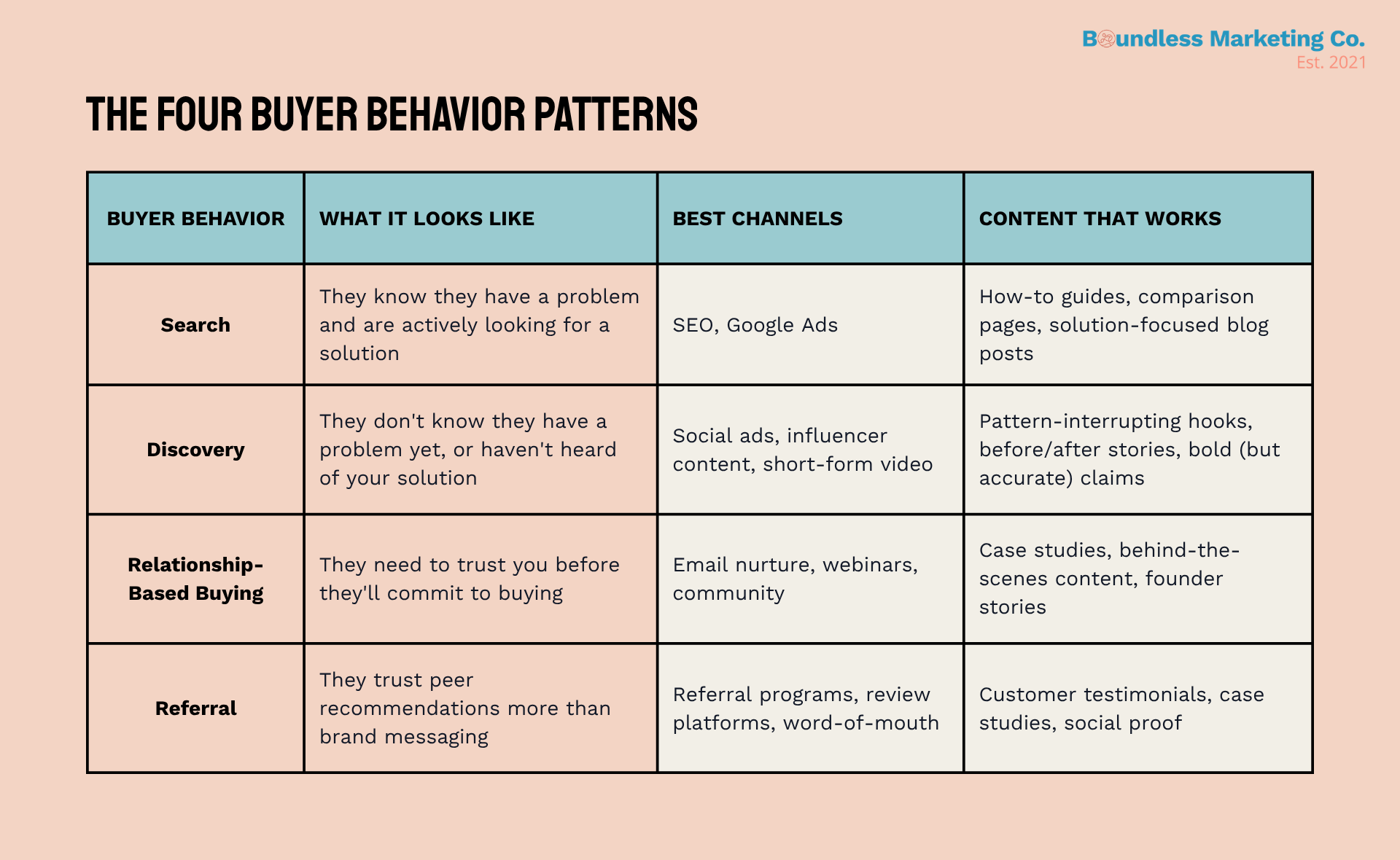
Every buyer, in every category, falls into at least one of four behavioral patterns when they're evaluating a purchase. These patterns don't describe who your buyer is demographically; rather, they describe what your buyer does when they're looking for what you sell.
Here's a quick reference before we go deeper on each one:
Pattern 1: Search Behavior
What it looks like
Search buyers know they have a problem, and they're actively looking for a solution. They're typing queries into Google. They're reading comparison articles. They're visiting product review sites. The intent is there; they just haven't found the right answer yet.
This is the most conversion-friendly buyer type because intent is already present. You don't have to convince them that a problem exists or that a solution is possible. You just have to show up in the right place at the right moment and make a compelling case for your business.
Channels that work
SEO and Google Search Ads are the primary channels here. SEO earns you organic placement in search results over time. Search ads let you show up immediately for high-intent queries while your SEO authority is still building.
Content marketing also plays a key supporting role. Buyers in search mode aren't just looking at product pages. They're reading guides, comparisons, and how-to articles before they ever talk to a salesperson. Publishing the most useful content in your category is one of the best ways to earn trust during that research phase and boost your credibility.
Search behavior in the wild
A founder building a contract management tool for law firms knows that office managers at small firms are actively searching for alternatives to manual contract tracking. They're Googling things like "contract management software for law firms" or "best legal contract tools for small practice." SEO content targeting those phrases is a direct line to a buyer who's already raising their hand.
B2C Marketing: What Actually Works
Consumer attention is fragmented and fast-moving. Short-form video on TikTok, Instagram Reels, and YouTube Shorts meets consumers where they already are and delivers your message in the format they are most likely to engage with. Paid social ads let you reach highly specific consumer segments at scale, test multiple creative angles quickly, and optimize toward purchase in a way that is measurable from day one.
Influencer partnerships
Social proof is one of the most powerful forces in consumer decision-making, and influencers are essentially professional social proof machines. A well-matched influencer partnership, especially with micro-influencers who have highly engaged niche audiences, can drive consumer trust in ways that brand advertising cannot replicate.
Reviews and ratings
Consumer buyers read reviews. For most e-commerce and consumer app categories, your review profile on Google, the App Store, or category-specific platforms is more influential than any ad you could run. Building a systematic process for earning reviews from happy customers is one of the highest-leverage marketing activities a B2C company can invest in.
Retargeting and lifecycle email
Even in B2C, email plays an important role, particularly for recovering abandoned carts, re-engaging lapsed customers, and driving repeat purchases. The difference from B2B is that B2C email sequences are usually shorter, more visual, and more emotionally driven.
Pattern 2: Discovery Behavior
What it looks like
Discovery buyers either don't know they have a problem yet, or aren't aware that a solution like yours exists. They're not searching because they don't know what to search for. They need to be interrupted and introduced to a concept or product they haven't considered before.
This is a harder buyer to convert immediately, but it's often the only path to market for companies creating a genuinely new category. If your product solves a problem that buyers haven't named yet, you can't wait for them to find you.
Channels that work
Social ads and influencer content are the workhorses for discovery behavior. They let you reach people based on demographic and behavioral signals rather than search intent. Short-form video on platforms like TikTok, Instagram Reels, and YouTube Shorts is especially effective here because it's a format built to capture the attention of people who weren't necessarily looking for you.
The content that works best for discovery buyers tends to be pattern interrupting. A bold statement, a surprising before-and-after, or a description of a pain point the buyer recognizes but never had words for. The goal is to make someone stop scrolling and think, "Wait, that's exactly my problem."
Discovery behavior in the wild
Think back a few years and suspend your disbelief for this one. A founder building an AI-powered meeting summarizer knows that their buyers, busy managers who spend half their week in meetings, aren't searching for a meeting summarizer because they don't know the category exists yet. But they're on LinkedIn complaining about being stuck in back-to-back calls with no time to synthesize notes. A short video ad showing a manager's inbox the morning after using the tool, with every meeting already summarized and filed, can stop the scroll and create awareness that a solution exists.
Pattern 3: Relationship-Based Behavior
What it looks like
Relationship buyers are aware that solutions like yours exist, and they may even be considering you specifically. But they're not ready to commit yet. They need to trust you first. This is especially common in the B2B world, where the stakes of a wrong decision are high, the contract is significant, or the product requires meaningful organizational change to implement.
These buyers aren't slow because they're indecisive. They're slow because they're careful. They want to know that your product actually works, that your company will be around in two years, and that the person selling to them understands their industry.
Channels that work
Email nurture sequences, webinars, and community are the highest-leverage channels for relationship buyers. Each of these formats gives you repeated touchpoints over time, which is exactly what trust-building requires.
Email lets you deliver consistent value directly to someone's inbox across a timeline that can span months. Webinars position you as an expert and give buyers a chance to evaluate not just your product but your team. Community participation, whether in an existing space or one you've built, creates low-stakes, ongoing interaction that builds real familiarity.
Case studies and founder-led content also perform well here. Relationship buyers want to see proof, not generic promises.
Relationship-based behavior in the wild
A founder selling a workforce planning tool to HR leaders knows their buyers have been burned before by software implementations that promised transformation and delivered headaches. The typical evaluation cycle is three to six months and involves IT, legal, and the CFO. Rather than pushing for a demo on the first touchpoint, their marketing focuses on a monthly webinar series where real HR leaders share workforce planning strategies, a newsletter with original research, and a library of case studies from companies with recognizable names. By the time a buyer books a demo, they already feel like they know the company.
Pattern 4: Referral Behavior
What it looks like
Referral buyers trust people more than they trust brands. They're not going to be persuaded by your ads or your content, no matter how good it is. What they need is a trusted person in their network to tell them your product is worth their time.
This doesn't mean referral buyers are skeptics. It means they've learned over time that the most reliable signal of product quality is whether someone they respect uses it and recommends it. That's a rational approach to filtering an overwhelming number of options.
Channels that work
Referral programs, review platforms, and deliberate word-of-mouth strategies are your best tools here. A formal referral program with tracked links and rewards is one option, but it's not the only one. Sometimes, the most effective approach is simply having a systematic process for asking happy customers for introductions (we <3 SOPs!).
Review platforms like G2, Capterra, and Trustpilot also serve the referral buyer. When a prospect searches for your product or your category and sees dozens of detailed reviews from people with similar job titles and company sizes, that's a form of peer recommendation at scale.
Referral behavior in the wild
A founder selling an analytics tool to e-commerce operators knows that their buyers are active in private Facebook groups and Slack communities where they constantly swap tool recommendations. Rather than pouring budget into ads that those buyers will ignore, they focus on making their best customers wildly successful and then making it easy for those customers to share the love. A simple referral incentive, combined with an active presence in the communities where their buyers gather, has the capacity to generate a steady stream of warm inbound leads.
Most Buyers Use More Than One Pattern
It's worth noting that buyer behavior isn't singular. The same person might discover your product through a social ad (discovery), spend weeks reading your blog and attending your webinars (relationship), and then finally make their decision after a colleague recommends you (referral). Real buyer journeys are rarely linear, but many marketing strategies are built around rigid pipelines.
What does that mean for your business? Well, your channel strategy shouldn't be built around a single behavior pattern. It should be built around the primary pattern that drives initial awareness, then layer in supporting channels for the subsequent patterns. Later in this series, we’ll talk more about building “mini marketing strategies” for different stages of your customer journey.
When you’re starting out, figure out how your buyer first learns that a solution like yours exists, and optimize for that first. Then build channels for every stage that follows.
How to Use This Framework
Here's a simple exercise you can do in under 30 minutes. Talk to five of your best current customers and ask them one question: how did you first find out about us, and what made you decide to take the next step?
Their answers will tell you two things: which behavior pattern drove their initial awareness, and which channels were most influential in moving them toward a decision. Those are the channels you should be prioritizing right now, not the ones that are trending on marketing Twitter.
Build from what's actually working for real buyers in your market. Everything else is just noise.
Up Next: Part 6 introduces the Bullseye Framework, a structured method for testing channels systematically so you can move from a long list of possibilities to a single high-conviction channel bet.
About This Series: This post is part of The Startup Marketing Playbook, a 12-part newsletter and blog series for tech and SaaS founders. Each installment covers one core concept in depth, with actionable frameworks you can apply immediately.