
The Bullseye Framework: A Step-by-Step Guide to Finding Your Winning Acquisition Channel
PART 6 OF 12 | THE STARTUP MARKETING PLAYBOOK | BLOG POST

The Channel Indecision Trap
Here's a pattern I see in a lot of marketing conversations at early-stage startups.
The founders know they need to market their product. They've read enough to know there are lots of channels to choose from. LinkedIn, email, SEO, paid ads, podcasts, influencers, community, cold outreach, etc. Every mentor, family member, and friend has an opinion about which will be best for their business. So they try a few of them simultaneously, put modest effort into each, and then wonder after 60 days why nothing seems to be working.
Or sometimes I meet founders that are hyper-fixated on one channel that worked wonders in the early days of business. They blew up on Instagram, but now that they’re scaling, Instagram simply isn’t cutting it. They can’t get past the idea that their hallmark channel in year one isn’t the best fit for growth in year three.
The problem isn't the channels. It's the approach. Doing five things at 20% effort produces worse results than doing one thing at 100% effort–especially early on, when you don't have the team, budget, or data to run multiple channels effectively.
The Bullseye Framework, developed by Gabriel Weinberg and Justin Mares in their book Traction, is a structured method for getting out of that trap. It helps you move from a long list of possibilities to a single high-conviction channel bet, and it does it through testing rather than guesswork.
Why the Bullseye Framework Works
Most channel selection decisions are made based on one of three inputs: what the founder is personally comfortable with (or what has worked for them in the past), what a competitor is doing, or what someone read about in a recent article (or, let’s be real, saw in a recent TikTok video). None of these are reliable signals for what will actually work for a specific business with a specific buyer.
The Bullseye Framework replaces those unreliable inputs with a repeatable process: consider everything, narrow to the most promising option or options, test cheaply, and double down on what works. It's designed to be fast, low-cost, and evidence-based.
The goal of the Bullseye Framework isn't to find the best channel in theory. It's to find the channel that works best for your specific buyer, your specific offer, and your current stage of growth.
The Three Rings
The framework gets its name from a dartboard. There are three rings, each representing a different stage of the channel selection process.
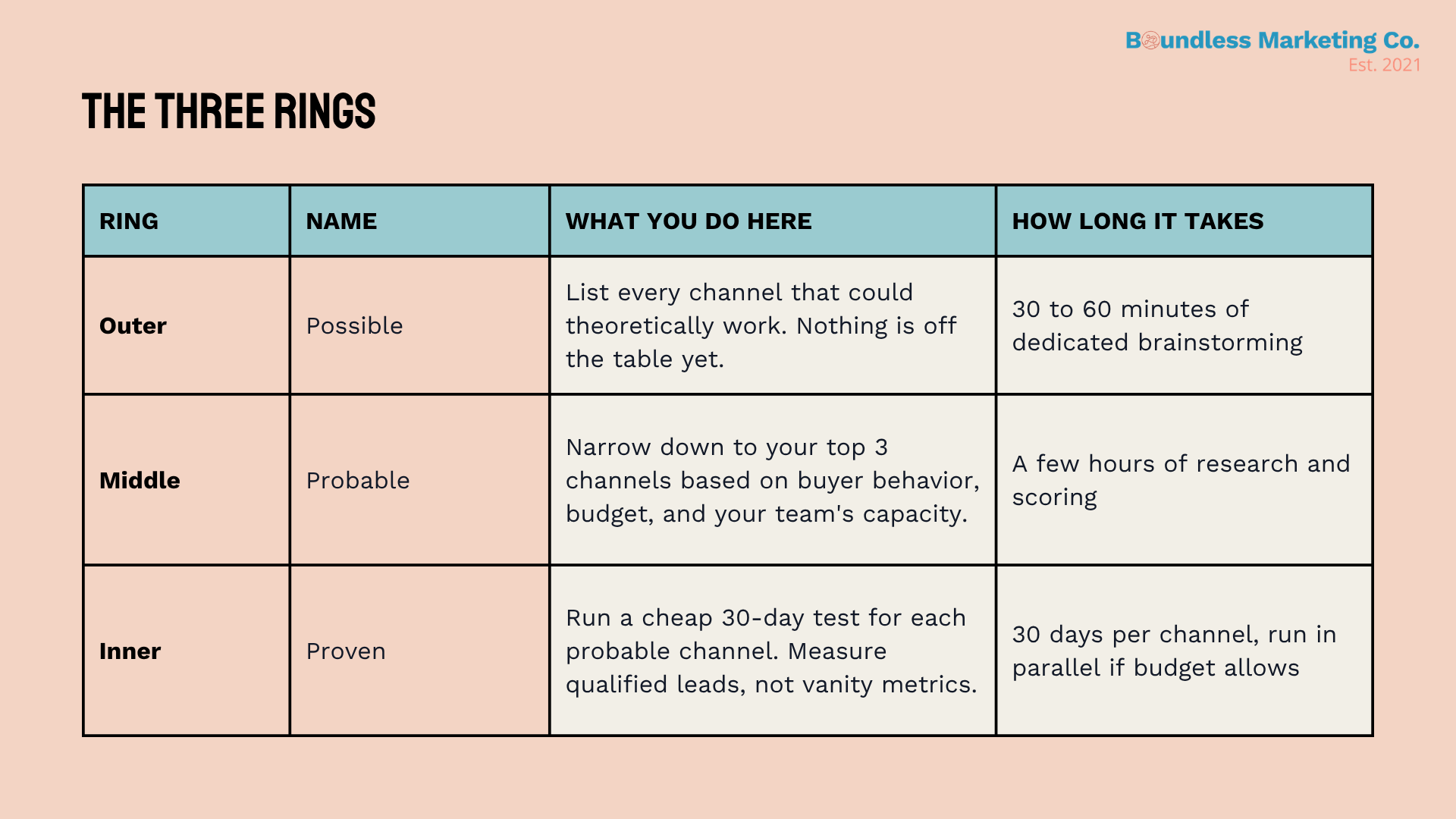
The Outer Ring: Possible
This is your brainstorm. The goal here is breadth, not depth. You want to consider every channel that could conceivably work for your business without ruling anything out prematurely. Include all of your big ideas, cool ideas you saw on social media, and whatever your next door neighbor thinks you should try.
A useful starting point is the PESO model (learn more here!). Broken down by type of channel, the model covers a huge array of potential marketing tactics for you to consider.
Don't disclude channels just because they seem unfamiliar or uncomfortable. The outer ring is about possibility, not preference or even feasability. Some of the most effective acquisition channels for early-stage startups are ones the founders never considered until they were forced to.
Now, quickly score each option in the outer ring from one to five, with five being the most probably to make progress towards your marketing goals. Consider buyer fit, your team's ability to execute, and your available budget. Don’t think too hard about this–select a rating based on your first instinct, with the three aforementioned criteria in mind.
The Middle Ring: Probable
Take your outer ring ratings and identify your top two to three channels. For each probable channel, write a simple hypothesis. A good hypothesis has three parts: what you're going to do, who you're going to reach, and what result you expect. For example: 'If we send 500 personalized cold emails to operations managers at SaaS companies with 50 to 200 employees, we expect 20 qualified replies and 5 booked calls within 30 days.'
The hypothesis doesn't have to be right. It just has to be specific enough that you can look back at it in 30 days and know whether it was validated or falsified. Vague hypotheses produce vague learnings.
The Inner Ring: Proven
This is where most frameworks stop giving advice, and most founders start making expensive mistakes. The inner ring is about testing, not launching.
A Bullseye channel test is not a full campaign. It's a minimum viable experiment designed to answer one question: Does this channel produce qualified leads for our business at a cost and effort level we can sustain?
The key distinction is between signal and scale. You're not trying to generate 100 leads from this test. You're trying to find out whether the channel is capable of generating qualified leads at all. Once you've confirmed that, you scale. If you try to scale before you've confirmed a signal, you're just spending more money to learn the same lesson slower.
How to Design a 30-Day Channel Test
A well-designed channel test has six components. Define all of them before you start, not after. Surprisingly, I see this mistake made quite often. Setting up quality tracking takes time, but it’s worth delaying your test by a week to ensure you can gather the data needed to improve in the future. Do it right the first time.
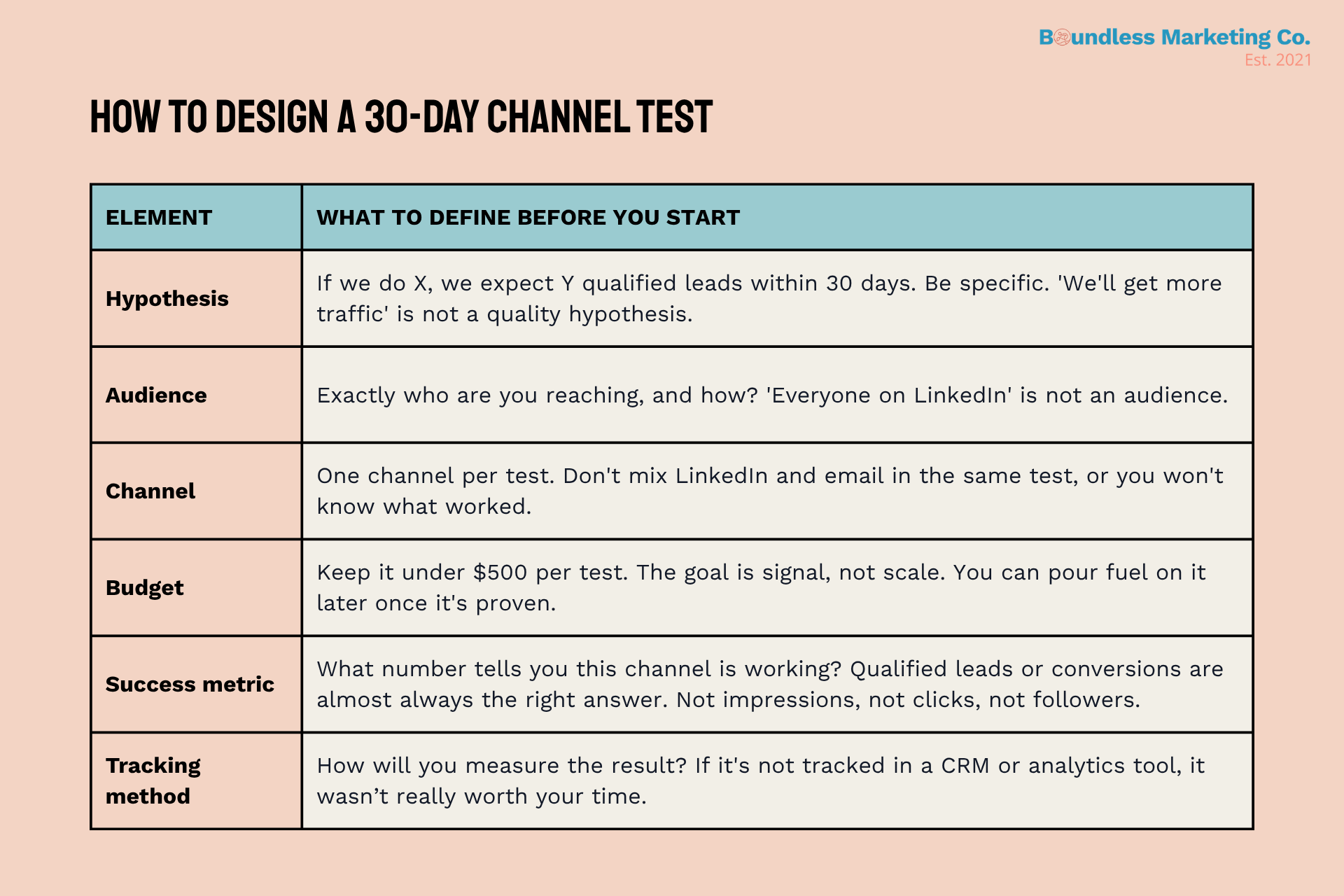
Once you've run all three tests, compare the results side by side. The channel with the best qualified lead or conversion rate–not the best vanity metrics, but the actual number of people who expressed genuine interest in your product–is your bullseye.
Example: What a 30-Day Test May Look Like
Let's say you're building a project management tool for architecture firms and you've identified three probable channels: LinkedIn thought leadership, cold email outreach to firm partners, and SEO targeting search terms like 'project management software for architects.'
LinkedIn test:
You post 3 times a week for 30 days, with content that specifically addresses project management challenges in architecture. Your hypothesis is that 30 days of consistent posting will produce at least 10 meaningful conversations with architecture firm partners or project managers. You track this by counting direct messages, connection requests from your target audience, and profile views from people at architecture firms.
Cold email test:
You build a list of 200 architecture firm partners and send a personalized five-email sequence over 30 days. Your hypothesis is that a 10% reply rate will produce 20 conversations, and at least 5 will be qualified enough to book a call. You track replies, call bookings, and the factors in your emails that drove the most positive responses.
SEO test:
You publish four well-researched blog posts targeting specific long-tail keywords your buyers are searching for. Your hypothesis is that within 30 days, you'll see initial rankings for at least two of those keywords and start generating organic traffic. You track keyword rankings, organic sessions, and whether any of those sessions convert to newsletter signups.
After 30 days, you review the results. The cold email sequence generated 18 replies and 6 booked calls. LinkedIn generated strong engagement, but only 2 direct conversations. The SEO posts are ranking but haven't generated significant traffic yet. The data tells you cold email is your bullseye for now. You stop splitting your attention and go all in on cold email until it stops working.
Here’s the bottom line: the test results don't have to be dramatic to be useful. Even a channel that completely fails tells you something valuable: where not to spend the next 30 days.
TL;DR: Focus One One Tactic Until It Stops Working
The most important principle of the Bullseye Framework is also the hardest one to follow: once you find a channel that works, stop testing the others.
I know this feels counterintuitive. Most founders want to keep their options open, myself included! But the compounding returns of going all-in on one channel are almost always greater than the diluted returns of running three channels at half capacity.
The time to add a second channel is when the first one has been fully exploited–aka, when you've squeezed as much growth out of it as it can reasonably deliver. You’ll know this is the case when you start to see diminishing returns (and the only way to know this is by continuing your tracking and reporting!). At that point, you run the framework again, find your next bullseye, and layer it on top of the first.
This is how great startup marketing engines are built: one proven channel at a time, stacked on top of each other over months and years. Not everything at once from day one.
Common Mistakes to Avoid
Testing three channels at different effort levels and concluding that the high-effort one won. The variable is effort, not channel quality. Test everything at the same intensity.
Measuring success with vanity metrics. Follower counts, impressions, and website sessions don't tell you whether a channel produces buyers. Qualified leads do.
Quitting a test before 30 days because the early results are slow. Most channels take time to warm up, and even 30 days is a short window. A cold email sequence that generates zero replies in week one might generate 20 in week three once the follow-up sequence kicks in.
Running the same channel test that your competitor is running. Their buyer behavior may be different from yours. Use the behavior pattern framework from part 5 to guide your test selection, not competitive imitation.
Treating the bullseye channel as permanent. Every channel eventually saturates. Build the habit of running a new Bullseye test every quarter or so; that way, you won’t ever be caught flat-footed when your primary channel slows down.
Wrapping It Up
Channel selection doesn't have to be a gut-feel exercise or a committee debate. The Bullseye Framework turns it into a structured, evidence-based process that any founding team–or even young team members–can run with minimal budget and a month of focused effort.
The goal isn't to find the perfect channel. It's to find your best channel right now: the one that works for your buyer, your offer, and your current stage. Everything else is just noise until you've found that.
Up Next: In Part 7, we shift from channel selection to conversion tracking. We'll introduce the six milestones every customer passes through on the way to a closed deal, and show you how to build a mini-plan for each stage of the pipeline.
About This Series: This post is part of The Startup Marketing Playbook, a 12-part newsletter and blog series for tech and SaaS founders. Each installment covers one core concept in depth, with actionable frameworks you can apply immediately.