
The 6-Stage Conversion Blueprint Every Startup Needs
PART 7 OF 12 | THE STARTUP MARKETING PLAYBOOK | BLOG POST

The Problem With Thinking of Your Funnel as a Funnel
The word 'funnel' implies that marketing is mostly a volume game: pour enough people in at the top, and some percentage will trickle out as customers at the bottom. This mental model is responsible for an enormous amount of wasted marketing spend.
The real challenge isn't volume; rather, it's movement. Leads may get stuck in the top stages of the funnel because there simply isn’t a compelling reason to express additional interest or take additional action. The question isn't “how do we get more people into the funnel?” Instead, ask yourself, “Why do people stop moving through it, and what does marketing need to do at each stage to keep them going?”
To answer that question, you need to stop thinking of your funnel as a single object and start thinking of it as six distinct stages, each with its own goal, metric, and mini-plan. And instead of picturing leads flowing seamlessly through the “funnel,” imagine your marketing team pulling them through each stage.
Why Stage-Specific Marketing Matters
Here's a scenario that plays out constantly in early-stage companies. The marketing team is generating a healthy number of leads every month. The sales team complains that the leads are low-quality. Marketing argues that they're hitting their lead volume targets. Sales argues that the leads never convert. Meanwhile, the actual problem is sitting unexamined somewhere in the middle of the funnel.
Stage-specific marketing solves this by giving you a map. Once you can see each stage clearly, with a defined metric and a defined tactic, you can pinpoint exactly where movement is breaking down. Is it at the awareness stage? At the trust stage? Are people requesting demos but not showing up? Is the problem that sales is taking too long to follow up? Each of those is a different problem with a different marketing solution.
The Six Milestones
Here's how the six stages of a typical funnel break down, along with what to track and what your mini-plan goal should be for each.
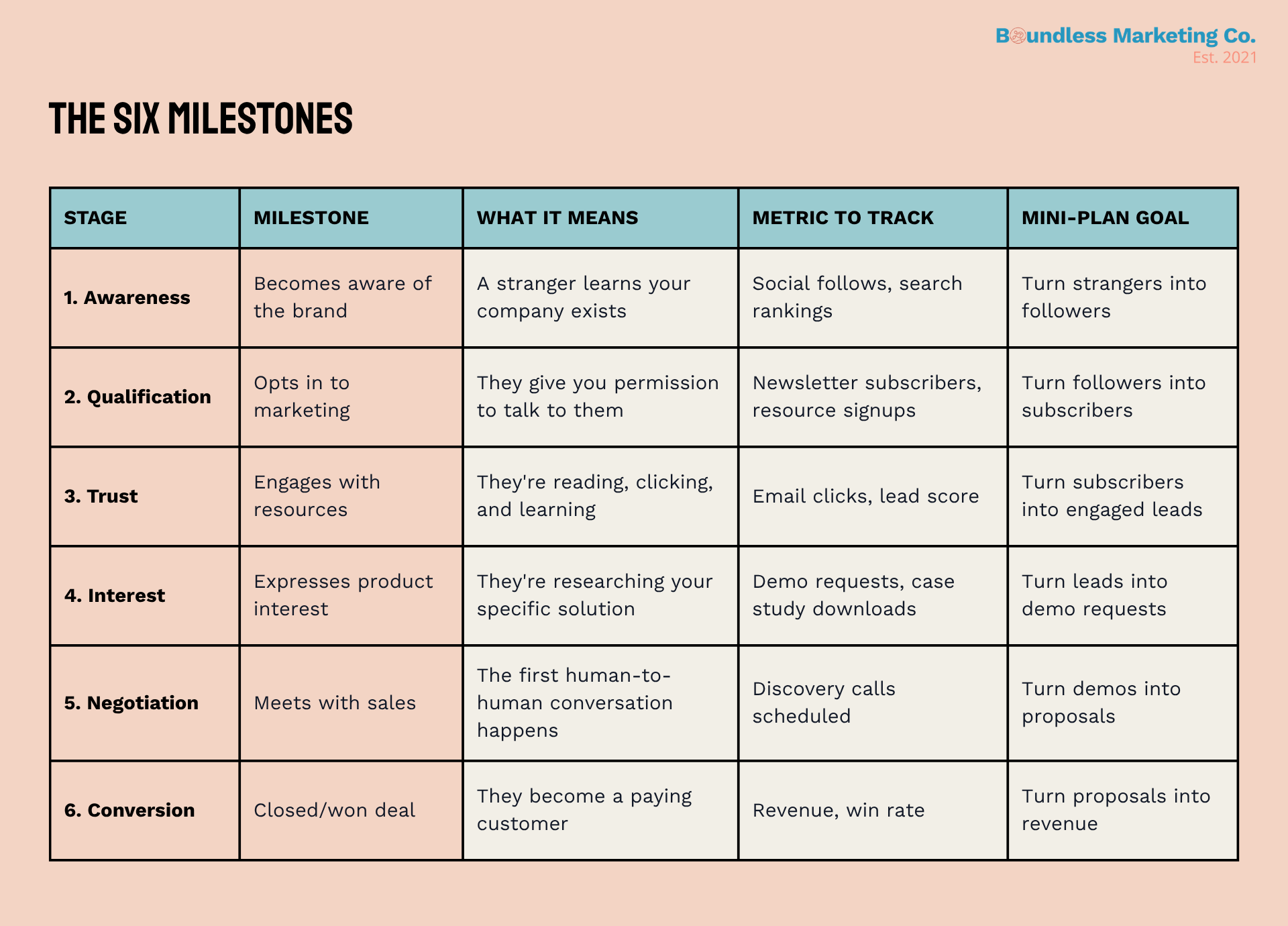
Read on to dive deeper into each stage’s marketing goals, how to track them, and how to troubleshoot when things go awry.
Stage 1: Awareness
Awareness is where a stranger learns that your company exists. This can happen through organic social content, a Google search, a podcast mention, a referral from a colleague, or a dozen other channels. The metric here is reach: social follows, search impressions, and website traffic from new visitors.
The mistake most startups make at this stage is treating their follower count as a success metric. Follower count is a lagging indicator of reach, and it tells you nothing about whether the right people are finding you. True, a growing follower account means your awareness is improving, and that’s the core goal in stage one. But a better long-term metric is whether your content is reaching people who match your ideal customer profile.
Stage 2: Qualification
Qualification is the moment a stranger gives you permission to talk to them. They sign up for your newsletter, download a lead magnet, register for a webinar, or join your waitlist. This is a significant moment because it signals that they've decided you're worth a slice of their attention.
The metric here is opt-in conversion rate: the percentage of page visitors who take the action of subscribing or signing up. If your landing page is getting traffic but not converting, the problem is usually one of two things: the offer isn't compelling enough, or the copy isn't making the value clear.
The thing most founders overlook at this stage is how low the bar needs to be for the initial opt-in. The harder you make it to give you their email, the fewer people will do it. A simple newsletter signup with a clear, specific value proposition almost always outperforms a complex lead magnet that requires filling out a form. Can you make your opt-in action require one click? If so, you’re on track.
Stage 3: Trust
Trust is built over time through repeated valuable interactions. The leads in your email list or social following who are in the trust stage are reading your content, clicking your links, and gradually forming an opinion about whether you actually know what you're talking about.
The metrics here are email open rate, click-through rate, and lead score. Lead scoring is particularly useful because it provides a composite view of engagement across multiple behaviors. A lead who opens every email, visits your pricing page, and watches your demo video is much further along the trust curve than a lead who opened one email six weeks ago, even if their lead age is identical.
The mini-plan for this stage is a consistent, valuable email nurture sequence. Not promotional blasts about your product, but genuinely useful content that helps your leads do their jobs better. When they associate your brand with 'this is the resource that helps me think clearly about my problem,' trust follows naturally.
Stage 4: Interest
Interest is the stage where a lead shifts from learning about the problem space in general to researching your specific solution. They're visiting your pricing page. They're downloading case studies. They're watching your product demo video. They're comparing you to alternatives.
This is where intent signals become critical. A lead who visits your pricing page is telling you something important. A lead who downloads a case study about about their exact industry is telling you something even more important. These actions should be tracked and, in an ideal world, trigger automatic increases in lead scores and proactive outreach from your team.
The most important thing to get right at this stage is response speed. If someone fills out a demo request form and doesn't hear back for 24 hours, your chances of qualifying them drop significantly. Research consistently shows that responding to an inbound demo request within five minutes dramatically increases the likelihood of connecting with that lead. Build the process to support that speed before you need it.
Stage 5: Negotiation
Negotiation is the first human-to-human interaction: the discovery call, the demo, the proposal review. This is traditionally considered a sales stage, not a marketing stage. But marketing has a critical supporting role here: arming the sales team with the right content at the right moment.
The metric to watch here is the discovery-to-proposal rate. If you're running ten discovery calls a month, but only two of them result in a proposal, that's a qualification problem. In other words, your marketing is letting the wrong people into the sales conversation. The fix is usually upstream at the qualification or interest stages, not in the sales script.
Marketing's job at this stage is to produce the case studies, one-pagers, ROI calculators, and comparison guides that sales need to close. These aren't glamorous pieces of content, but they're often the difference between a deal that closes and a deal that goes quiet after the second call.
Stage 6: Conversion
Conversion is straightforward: the deal closes, and the prospect becomes a customer. The metric is revenue and win rate.
But there's a marketing action that most teams skip at this stage that's actually one of the most valuable inputs: the closed-lost reason. Every deal that doesn't close should be tagged in the CRM with a reason. Was it the price? Timing? A missing feature? A competitor who got there first? This data, collected consistently over months, tells your marketing team exactly what objections to address in their content and exactly which messages are failing to land before the sales conversation even starts.
How to Build a Mini-Plan for Each Stage
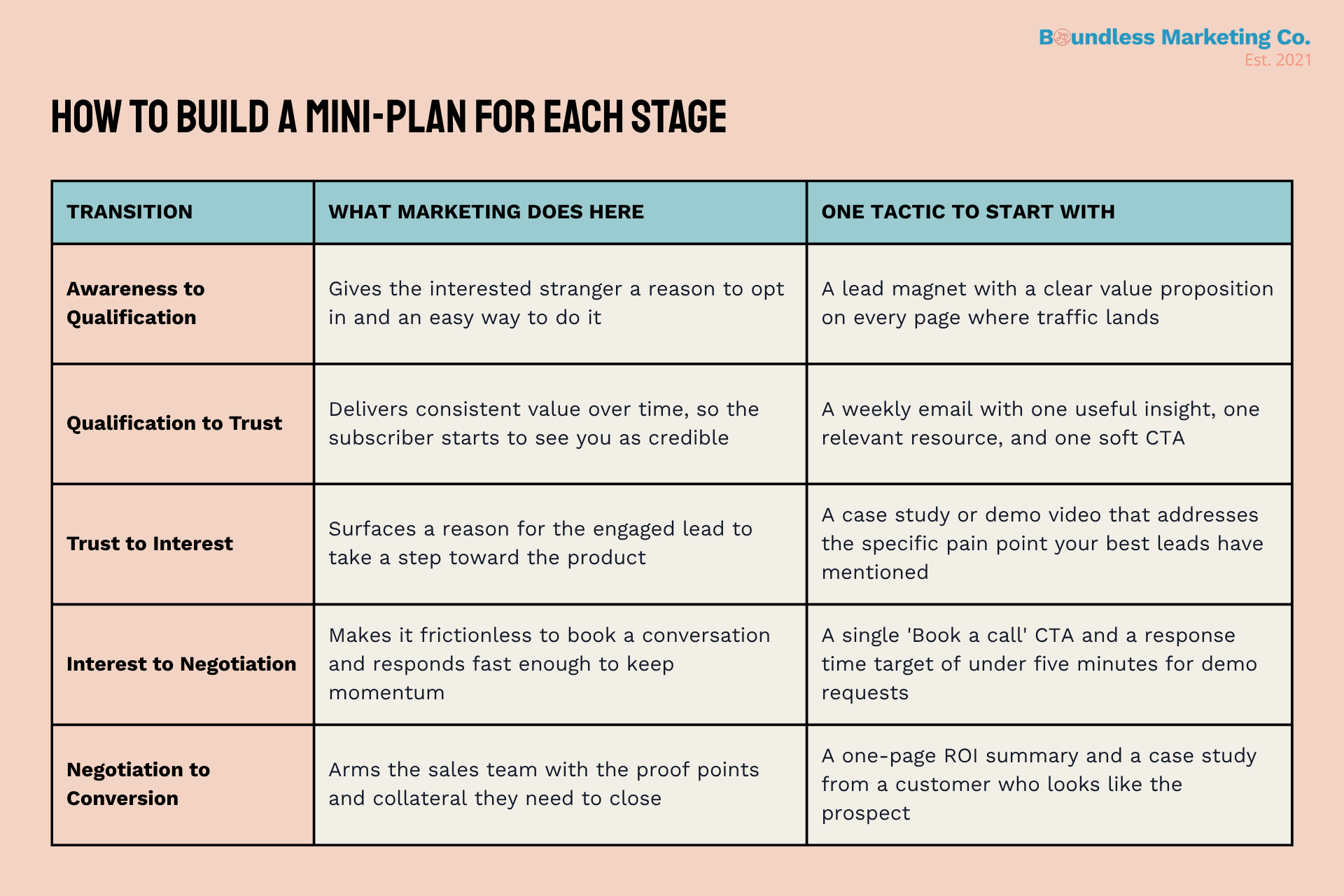
A mini-plan doesn't have to be complicated. For each stage transition, you need three things: a goal (what action are you trying to drive?), a tactic (what specific thing will you do to drive it?), and a metric (how will you know it's working?).
Here's what that looks like in practice across all five stage transitions.
The Most Common Bottleneck–And How to Find Yours
Once you have metrics defined for each stage, finding your bottleneck is simple: look for where the biggest drop-off in volume happens.
If you have high website traffic but low opt-in rates, your bottleneck is at the awareness-to-qualification transition. Your lead magnet or newsletter offer needs work.
If you have a large email list but low engagement, your bottleneck is at the qualification-to-trust transition. Your nurture content isn't delivering enough value.
If you have engaged subscribers but few demo requests, your bottleneck is at the trust-to-interest transition. You're not surfacing strong enough product proof at the right moment.
If you have lots of demo requests but a low show rate, your bottleneck is at the interest-to-negotiation transition. Your confirmation and reminder sequence needs attention.
If you're running great discovery calls but not producing proposals, your bottleneck is in the qualification stage. The wrong people are getting into the sales conversation.
Fix the biggest bottleneck first. Adding more volume at the top of a leaky funnel just means more wasted effort. Patch the leak before you pour in more water.
The Bottom Line
A conversion blueprint isn't a complicated thing to build. It's six stages, each with a defined goal, a metric, and a mini-plan for moving people forward. The startups that get this right stop arguing about whether marketing is working and start making evidence-based decisions about where to focus.
Build the blueprint before you need it. The time to design your stage-specific marketing plans is before you're generating leads at scale, not after.
Up Next: Part 8 goes deep on the specific metrics that tell you whether your awareness and engagement stages are actually performing — and how to tell the difference between numbers that feel good and numbers that actually matter.
About This Series: This post is part of The Startup Marketing Playbook, a 12-part newsletter and blog series for tech and SaaS founders. Each installment covers one core concept in depth, with actionable frameworks you can apply immediately.